
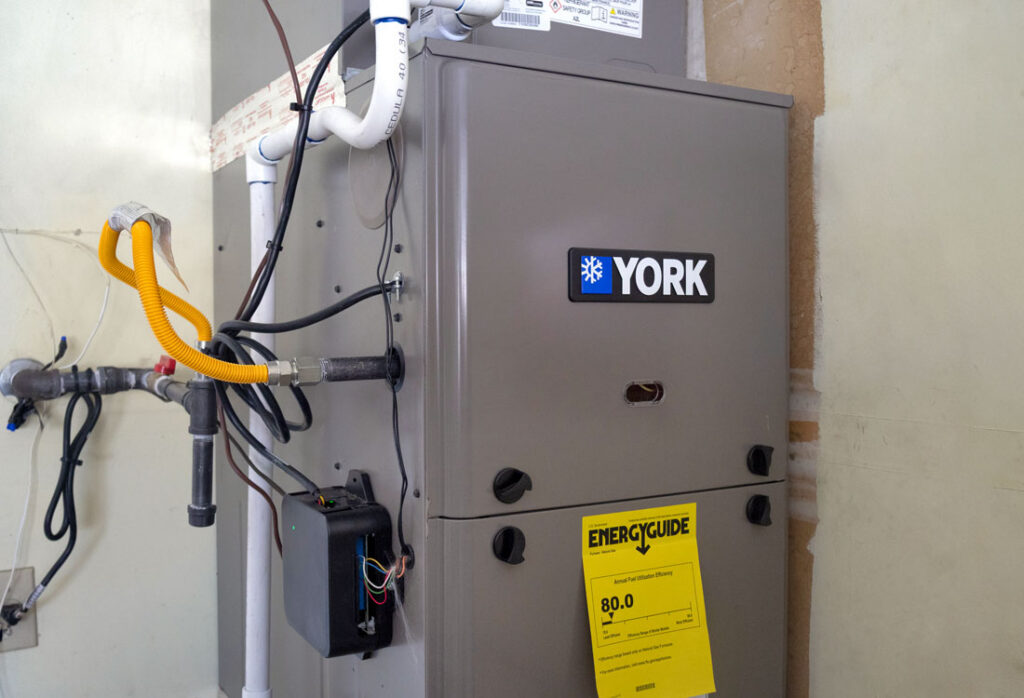
A cracked heat exchanger is one of the few furnace diagnoses that can end with the heat shut off and a replacement quote on the table the same day. It can be a real carbon monoxide hazard, and it’s also a finding you can ask to see. Here’s how Wally Falke’s technicians handle it in Turlock and Modesto.
What Is a Cracked Heat Exchanger, and Is It Dangerous?
A heat exchanger is the metal chamber inside a gas furnace that keeps the burner’s flame and exhaust separate from the air your blower pushes through the house. The exhaust, including carbon monoxide, is supposed to leave through the flue. A crack breaks that separation: exhaust can leak into the airstream, or blower air can push into the burner and disturb the flame. Either one is a safety problem, which is why a technician who confirms a crack will shut the furnace off.
Most cracks come from years of heating up and cooling down, and they come sooner when restricted airflow makes a furnace run hot: a clogged filter, closed registers or undersized return ducts. That’s one reason every heating tune-up includes a look at the heat exchanger. California law requires a carbon monoxide alarm in homes with gas appliances. If yours sounds, get everyone out first, and once you’re well away from the house, call 911 and PG&E at 1-800-743-5000.
How Does a Technician Confirm a Crack?
No single test catches every crack, so a solid diagnosis rests on more than one kind of evidence. Some cracks are hard to see inside a modern furnace, and some only open when the metal is hot. These are the checks that carry the most weight:
| Evidence | What the technician does | What it tells you |
|---|---|---|
| Visual or camera inspection | Looks at the heat exchanger with a light, mirror or inspection camera | A visible crack or hole is the strongest single proof. Ask for a photo or video. |
| Flame test | Watches the burner flame as the blower starts | A flame that jumps, bends or changes color when the blower comes on suggests air is getting through an opening |
| Combustion analysis | Measures oxygen and carbon monoxide in the exhaust, then watches whether the numbers change when the blower starts | A jump at blower start points to a breach, and the readings show how serious it is |
| CO check at the vents | Tests the air coming out of the supply registers while the furnace runs | Any carbon monoxide in the house air means the furnace stays off until it’s fixed |
Readings can also shift because of a leaky return duct near the furnace, so one odd number isn’t proof on its own. A photo plus readings that change at blower start is a much stronger case.
What Should You Ask to See Before Replacing the Furnace?
Ask for the evidence before you sign anything. It’s a normal request, and a technician who found a real crack will expect it:
- A photo or video of the crack, and where it is on the heat exchanger
- The combustion readings, before and after the blower starts
- The furnace’s model number, serial number and install date, so you can check the warranty
- Written prices for both options: a new heat exchanger and a new furnace
With those in hand you can decide on the facts. If some are missing, a second look is reasonable. You can also check any contractor’s license on the Contractors State License Board site, cslb.ca.gov.
Is a Cracked Heat Exchanger Covered by Warranty?
Often the part is covered and the labor isn’t. Most major furnace brands warranty the heat exchanger far longer than the rest of the furnace. Carrier, for example, covers it for life on a furnace registered within 90 days of installation, and for 20 years if it wasn’t registered. Labor is separate: unless the installer included a labor warranty, you pay for the hours, and swapping a heat exchanger typically takes four to eight of them. Nationally, a heat exchanger replacement runs about $1,250 to $3,000.
That’s why the install date matters. An eight-year-old furnace with a covered heat exchanger is a very different decision from a 22-year-old furnace whose part is out of warranty or no longer made.
Should You Replace the Heat Exchanger or the Whole Furnace?
Wally Falke’s uses the same rule here as on any big furnace repair: when the repair costs more than about half the price of a new furnace and the furnace is 15 years or older, replacement is usually the better value. As a cross-check, multiply the furnace’s age by the repair cost; past $5,000, replacement deserves a look. A new 80% single-stage gas furnace runs $4,000 to $6,000 installed with us, and a 90% or higher two-stage or variable-speed model runs $6,000 to $10,000. Our furnace replacement cost guide breaks those numbers down.
| Your furnace | Usually the better call | Why |
|---|---|---|
| Under 15 years, heat exchanger under warranty | Replace the heat exchanger | You pay labor only, on a furnace with years left |
| Under 15 years, part out of warranty | Price both | Part plus labor can reach half the cost of a new 80% furnace |
| 15 years or older | Replace the furnace | The repair usually crosses the half-cost line, and other parts are aging too |
Our short heating season is easy on furnaces, so age alone doesn’t settle it. About one in three Modesto homes was built between 1960 and 1979, and those are the houses where we most often find aging heat exchangers. If you do replace, price a heat pump first. TID and MID pay nothing toward a new gas furnace but $450 to $1,500 toward a qualifying heat pump; here’s what a heat pump costs after TID and MID rebates.
When Does a Second Opinion Make Sense?
A second opinion makes sense when the evidence is thin, the furnace is fairly young, or the only option you were given is a new system. It is not a reason to keep the furnace running. If carbon monoxide showed up in the house air or your alarm sounded, the second opinion happens with the heat off.
Wally Falke’s gives a free second opinion when another contractor has recommended an expensive heating repair or a full replacement. We’ll inspect the furnace, run the carbon monoxide and gas-leak check we do on every heating call, and explain what we find. Sometimes the answer is a repair. A June review put it this way: “Thought we needed to replace old system. Technician sent out, Gavin, was professional, competent in checking system and came up with solution that saved us thousands of dollars.” Sometimes we agree that replacement is the right call, and we’ll tell you that just as plainly.
Frequently Asked Questions
Can I run my furnace with a cracked heat exchanger?
No. Wally Falke’s recommends keeping a furnace with a confirmed or strongly suspected crack off until it’s repaired or replaced, even if the CO alarm is quiet. If you need heat in the meantime, use electric space heaters plugged straight into a wall outlet and kept three feet from anything that can burn. Never heat the house with a gas oven, grill or outdoor heater.
Will a carbon monoxide alarm warn me about a cracked heat exchanger?
Not reliably. A CO alarm is built to sound when carbon monoxide builds to a harmful level over time, so a small leak that shows up on a technician’s analyzer may never set one off. Treat the alarm as your backstop and the yearly heating inspection as the real test.
Get a Free Second Opinion
If you’ve been told your furnace has a cracked heat exchanger, keep it off and call Wally Falke’s at (209) 632-7596 or schedule online. We’ll give you a straight answer, whether that’s a new heat exchanger or a new furnace. For other no-heat problems, see our furnace repair in Turlock and furnace repair in Modesto pages.

