Most Central Valley homeowners start shopping for a furnace replacement after a repair quote lands wrong, and the first number they find online is usually too low to be useful. Wally Falke’s Heating & Air Conditioning has been replacing furnaces in Modesto, Turlock, Merced, Manteca, Ripon, Riverbank, Ceres, Oakdale and Patterson since 1969, and we’d rather show you the real ranges than a national average that doesn’t survive contact with your house. If you’re pricing the cooling side too, we’ve published our AC replacement costs the same way.
How Much Does Furnace Replacement Cost in the Central Valley?
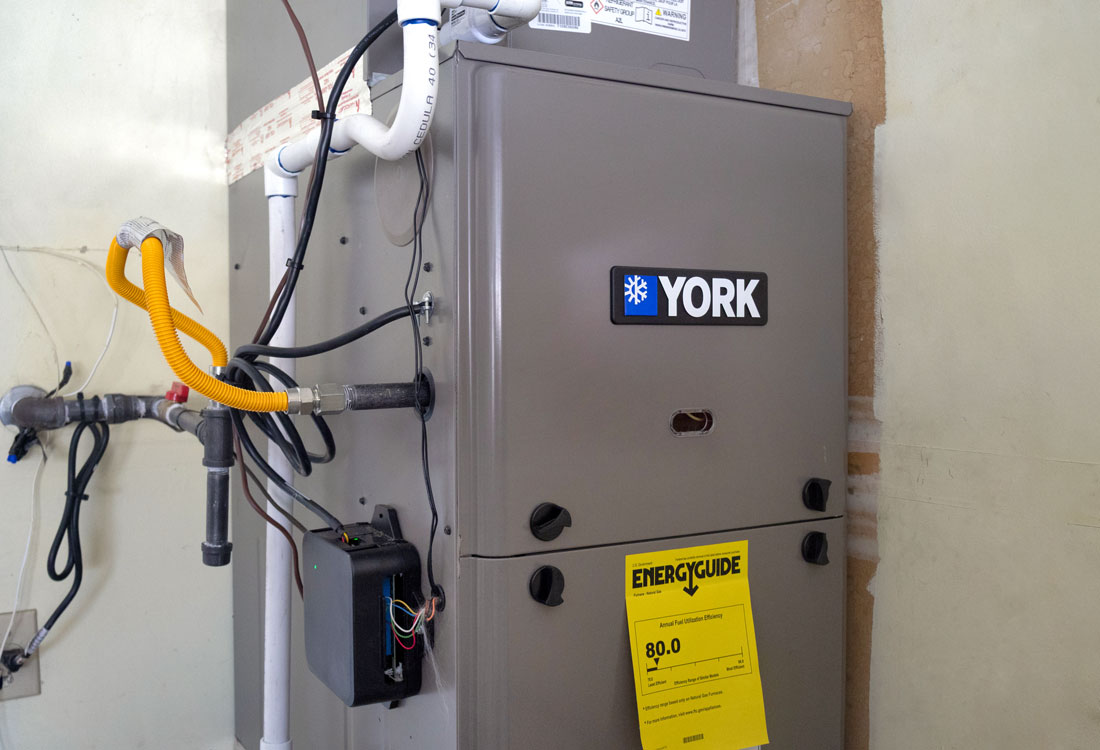
A standard 80% AFUE single-stage furnace replacement in the Central Valley typically runs $4,000 to $6,000 installed. A high-efficiency 90 to 98% AFUE two-stage or variable-speed furnace generally runs $6,000 to $10,000 installed. A dual-fuel system that pairs a heat pump with a gas furnace runs $10,000 to $16,000 installed. Where your project lands inside those ranges depends on five things: the size of the furnace, its AFUE efficiency rating, the condition of your ductwork, whether the gas line needs work, and the venting. Those are installed prices, not equipment-only prices, and they include the permit and haul-away of the old unit.
| System type | Efficiency | Installed price | Best fit |
|---|---|---|---|
| Single-stage gas furnace | 80% AFUE | $4,000 to $6,000 | Lowest upfront cost, and a sound choice for our mild winters |
| Two-stage or variable-speed gas furnace | 90 to 98% AFUE | $6,000 to $10,000 | Quieter, more even heat, lower winter gas bills |
| Dual-fuel heat pump and gas furnace | Varies by pairing | $10,000 to $16,000 | Heats and cools in one system, gas available on cold mornings |
We do not quote a new furnace over the phone. We come to your home, measure it, check the ductwork and venting, and give you a free in-home estimate with written options.
Why Online Furnace Cost Estimates Come In Below Your Quote
The gap between an online furnace estimate and a real Modesto quote is usually scope, not geography. Homewyse puts national furnace installation at $3,221 to $3,828, and its own page states the estimate does not include permit or inspection fees, “bringing any systems into compliance with current building codes,” modifying existing HVAC, electrical or plumbing, sales tax, or general contractor overhead and markup, which it says adds 13% to 22% when a general contractor supervises the job. Those exclusions are the exact line items that move a real replacement from the entry tier into the upper ones.
| Source | Furnace replacement cost | What the number covers |
|---|---|---|
| Homewyse (national) | $3,221 to $3,828 | Excludes permit, code compliance, tax and contractor markup |
| HomeAdvisor (national, gas furnace) | $3,800 to $10,000 | Equipment and labor |
| HomeCostLens (Modesto, 80% AFUE, 2,000 sq ft) | $5,780 average, $3,990 to $10,510 | Local labor and permit factored in |
| Wally Falke’s, installed, by system type | $4,000 to $16,000 | Equipment, labor, venting, permit, haul-away |
The national ceilings sit close to our floor, and HomeCostLens’s $5,780 Modesto average is specifically a 2,000 square foot home with an 80% AFUE gas furnace, which is our entry tier rather than a whole-market average. So a quote above the number you found tells you nothing by itself. What tells you something is whether it itemizes the equipment, venting, gas line, ductwork and permit, and whether anyone measured your home before writing it.
What Actually Moves Your Furnace Replacement Price
Sizing, efficiency tier, ductwork condition, gas-line work and venting account for most of the spread between a $4,000 quote and a $12,000 one, and only one of those five is the furnace itself. The single biggest swing is venting: moving from an 80% furnace to a 90%-plus condensing model means new PVC venting, because a condensing furnace can’t share the existing metal flue. That’s real labor, and it’s the most common reason two similar homes get very different quotes.
- Sizing, established by a load calculation. Ceiling height, insulation, window placement, sun exposure and duct layout all change the answer, so square footage alone doesn’t tell us what your home needs. An undersized furnace never catches up; an oversized one short cycles and wears itself out early. It’s the most expensive mistake in the project, which is why we calculate it rather than estimate it.
- Efficiency tier. Higher AFUE costs more upfront and less to run, and in our climate that trade-off is genuinely close.
- Ductwork condition. Leaking, undersized or poorly insulated ducts undercut a new furnace no matter how good it is. When the ducts are part of the problem, skipping them costs more over the life of the system.
- Permits and code compliance. We pull the permit and handle the inspection. If your existing install predates current standards, bringing it up to code can add scope.
When Is It Time to Replace Instead of Repair?
You don’t need every sign below to justify a replacement, but two or more usually means it’s time to price both options.
- Age. Gas furnaces typically last 12 to 20 years. Inside that range, with repairs becoming routine, start planning rather than reacting.
- Rising gas bills with no change in how you use the house.
- Repeat repairs. Two major repairs inside 18 to 24 months is a pattern, not bad luck.
- Uneven temperatures, or run times that keep stretching to hit the same setpoint.
- New noises. Rattling, grinding, booming on ignition, or a blower whine that wasn’t there last winter.
- Short cycling, meaning it starts and stops without reaching the thermostat setting.
- Visible rust or cracking, particularly around the heat exchanger or the venting.
- A yellow flame instead of a steady blue one. This points to a combustion or ventilation problem and needs a technician, not a wait-and-see.
Two of these are safety issues rather than budget issues. A cracked heat exchanger can leak carbon monoxide, and because the part is expensive, replacing the furnace is often the better value. If you smell gas or your carbon monoxide alarm sounds, do not try to find the problem yourself: shut the system off, get everyone outside to fresh air, and call us or your gas company right away. We run a carbon monoxide and gas-leak check on every heating service we perform, and a professional heating tune-up is how most of these get caught before they become emergencies.
Repair or Replace? Run the Numbers
Most furnace repairs are worth doing. The ones that aren’t follow a pattern you can check yourself in about a minute.
| Repair type | Typical cost | Worth doing? |
|---|---|---|
| Flame sensor, igniter, thermostat, capacitor | $150 to $600 | Almost always, at any age |
| Blower motor, gas valve, control board | $500 to $1,500 | Depends on the furnace’s age |
| Cracked heat exchanger | Expensive part, safety-critical | Usually points toward replacement |
Our rule of thumb: when a repair runs more than about half the cost of a new furnace and the unit is 15 years old or older, replacement is usually the smarter move. Under 15 years with a minor fix, repair almost always wins; see what furnace repair in Modesto typically costs. We charge a flat diagnostic fee that applies toward the cost of your repair, so you’re not paying twice for the visit and the fix. And if you’ll be in the home another three to five years or more, the efficiency and reliability gains have time to pay back. If you’re moving next spring, that math changes, and we’ll tell you so.
Should You Replace a Gas Furnace With a Heat Pump Instead?
A heat pump is a viable full replacement for a gas furnace in the Central Valley, and the reason is the local design temperature. Stanislaus County’s 99% winter design temperature is 27°F, with a summer design temperature of 100°F, per RESNET/ICC Appendix A (v4, 2019-09-27). Merced County is 29°F and San Joaquin County is 28°F. That matters because most heat pump advice online is written for climates that drop well below zero, where a gas furnace really is needed as backup. At 27°F, a properly sized modern heat pump carries the load on its own. The cold-weather objection that dominates furnace-versus-heat-pump content doesn’t apply to a Modesto or Turlock winter.
On efficiency, the honest comparison is definitional rather than a percentage. AFUE measures the share of fuel energy a furnace converts to heat, so a furnace is always below 100%. A heat pump doesn’t burn anything: it moves heat that already exists, so it delivers more heat energy than the electricity it draws. That’s why an all-electric home in a mild climate can come out ahead on operating cost even where gas is cheap.
Electric furnaces show up as the cheapest option on national cost tables, and in this market they’re usually the worst long-term buy. Electric resistance heat converts electricity to heat one-for-one, while a heat pump moves several times more heat than the electricity it draws, and TID and MID rebate the heat pump and not the resistance furnace.
Where a gas furnace still wins is upfront cost and simplicity, and a right-sized 80% AFUE unit remains a sound choice for many Central Valley homes. Dual fuel sits between the two and costs more upfront, which is a budget consideration rather than an argument for or against.
| Gas furnace | Electric resistance furnace | Heat pump | Dual fuel | |
|---|---|---|---|---|
| Installed cost | $4,000 to $10,000 | About $4,200 typical for Modesto | $11,000 to $18,000 ducted, see our heat pump cost breakdown | $10,000 to $16,000 |
| Handles a 27°F night alone | Yes | Yes | Yes, when properly sized | Yes |
| Also provides cooling | No | No | Yes | Yes |
| Operating cost | Moderate | Highest | Lowest | Low |
| TID or MID rebate | None | None | $450 to $1,500 | Check eligibility, the heat pump portion may qualify |
What Rebates Can Modesto and Turlock Homeowners Actually Get?
Neither Turlock Irrigation District nor Modesto Irrigation District pays anything toward a gas furnace replacement. Both pay toward a central heat pump: $450 to $700 from MID, $1,000 to $1,500 from TID. TID and MID are municipal utilities rather than PG&E, and both run their own rebate programs built around cooling and electrification, so a like-for-like gas replacement earns $0 from either one. That doesn’t automatically make a heat pump the right call, but it belongs in the comparison, and it’s worth several thousand dollars in some cases.
| Equipment | TID (Turlock) | MID (Modesto) |
|---|---|---|
| Gas furnace | $0 | $0 |
| Central heat pump | $1,000 | $450 to $700 per unit, by efficiency tier |
| Central heat pump, replacing gas (electrification) | $1,500 | Not offered as a separate tier |
| Central air conditioner | $500 | $350 to $600 per unit, by efficiency tier |
| Ductless mini split | $350 per ton | $350 per indoor head |
| Smart thermostat | $50 | $25 |
| HVAC tune-up | $50 | Not offered |
The fine print decides whether you actually collect:
- TID’s $1,500 electrification rebate requires proof you went off gas, meaning the invoice shows the gas line capped or removed. Six months to apply, rebates of $300 or less credited to your monthly statement, funds first-come, first-served.
- MID requires a C-20 licensed contractor in good standing, an AHRI certificate, a permit and a paid invoice. Two rebates per household, five-ton cap, 90 days to apply, and the amount depends on funding levels the day MID receives it.
- The federal tax credit is gone. The 25C Energy Efficient Home Improvement Credit and the 25D Residential Clean Energy Credit both terminated for property placed in service after December 31, 2025. If a contractor is still quoting you a federal credit on a 2026 install, that information is not current.
- Verify your own utility before counting on a number. Turlock is TID and most of Modesto is MID, but our service area is wider than those two districts. Manteca, Ripon, Merced and Los Banos homes get their electricity from PG&E or another provider, and so do parts of Oakdale and Riverbank. We check this during your estimate.
For the balance, GoGreen Home financing works through California credit unions and carries no property lien, which is the main difference between it and PACE financing, where the obligation attaches to your property and appears on your tax bill. For TID and MID customers, a heat pump is the cooling upgrade GoGreen will finance, and we also offer conventional financing options for repairs and replacements.
Frequently Asked Questions
How much does it cost to replace a furnace in a 2,000 square foot home?
In the Central Valley, a 2,000 square foot home usually falls in the $4,000 to $6,000 range for a standard 80% AFUE furnace or $6,000 to $10,000 for a high-efficiency model. Square footage is only a starting point, though. Insulation, window placement, ceiling height and duct condition can move a 2,000 square foot home into a different equipment size entirely, which is why we run a load calculation instead of pricing by the square foot.
Should a 25-year-old furnace be replaced?
Almost always, yes. Gas furnaces typically last 12 to 20 years, so a 25-year-old unit is past its service life, its parts are getting harder to source, and its efficiency has been drifting down for years. Wally Falke’s would still inspect it before recommending anything, because a well-maintained older furnace with a minor fault is occasionally worth one more season. But at 25 years, any repair over a few hundred dollars is money spent on a system you’ll replace soon anyway.
Is a high-efficiency furnace worth it in the Central Valley?
Often not, and we’d rather say so. Our mild winters mean a furnace runs far fewer hours than one in a cold climate, so there are fewer hours over which the efficiency premium can pay back. The upgrade earns its keep on a larger home, a longer stay, or a household that keeps the thermostat high. Moving to 90%-plus also means new venting, so compare total installed cost, not equipment price.
Are furnace prices going up in 2026?
Equipment platforms have changed, which affects pricing. New residential heat pumps and air conditioners now ship on low-GWP refrigerants, primarily R-454B or R-32, following the EPA technology transition rules for newly manufactured equipment. That’s a cooling-side change rather than a furnace change, but it affects dual-fuel and system-wide replacements. Your existing furnace can still be serviced, so this isn’t a reason to replace before you’re ready.
How long does a furnace last in the Central Valley?
Twelve to 20 years, and our mild winters push many systems toward the upper end of that because a Central Valley furnace runs far fewer hours than one in a cold climate. Annual maintenance is the difference between the two ends of that range.
Do you handle the permit, and what does it cost?
Yes. A mechanical permit is required for a furnace replacement in Modesto and typically runs $300 to $800, and Wally Falke’s pulls it and handles the inspection as part of the job. It’s included in the installed prices above rather than added afterward. If you’re switching to a heat pump and claiming a MID rebate, you’ll need a copy of that permit for the application, and we provide it.
Ready for a Real Number?
The only accurate furnace replacement price is one based on your home. Schedule a free in-home estimate and we’ll measure the house, check the ductwork, venting and gas line, confirm which rebates you qualify for, and give you written options for both repair and replacement. Most straightforward replacements finish in a single day, and every new installation is backed by our Triple Trust Parts, Labor and Workmanship Guarantee, a one-year money-back guarantee, and a 10-year parts and labor warranty on most systems. Call (209) 632-7596 or book online, and we’ll tell you honestly which way to go.