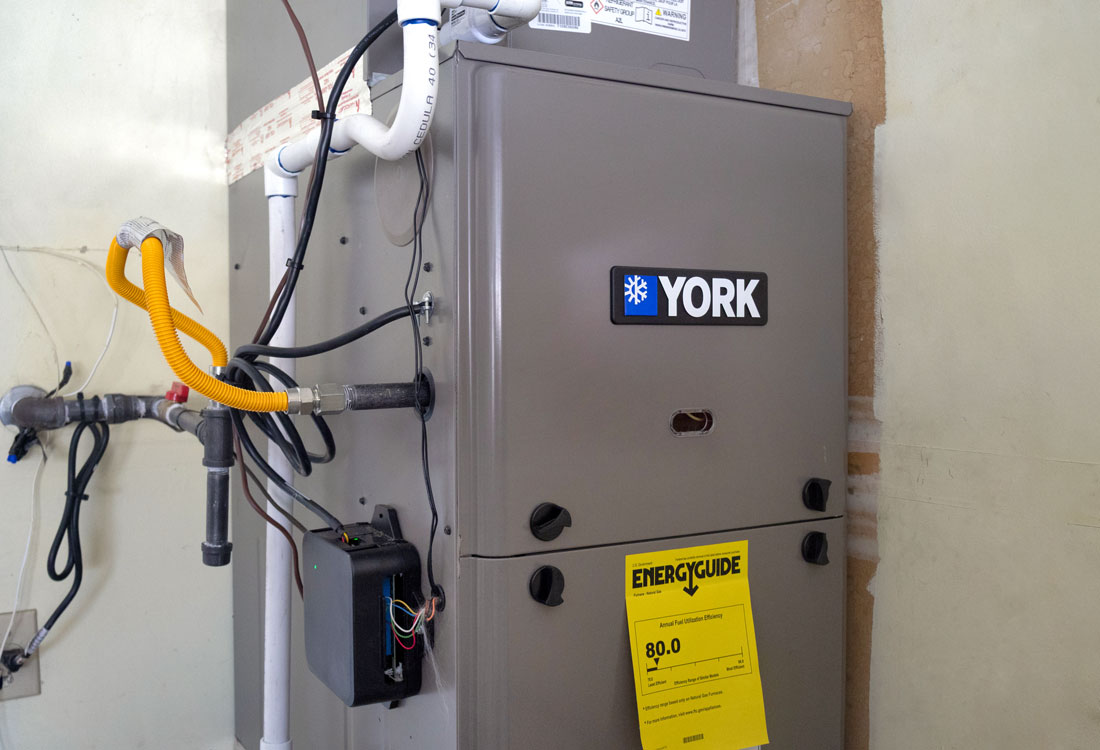
The filter in your furnace or air handler cleans every bit of air your system moves, and in the Central Valley it has a lot to catch: farm and road dust all year, wildfire smoke in summer and wood smoke in winter. Here’s how Wally Falke’s helps Turlock and Modesto homeowners pick a filter that fits both the air and the equipment.
What Does a MERV Rating Mean?
MERV (Minimum Efficiency Reporting Value) is a 1-to-16 score for how well an HVAC filter catches particles between 0.3 and 10 microns. The higher the number, the more small particles it traps. The test comes from ASHRAE, the engineering society behind most HVAC standards, so a MERV 11 from one brand should perform about like a MERV 11 from another.
| MERV | Minimum capture, by particle size | What that means at home |
|---|---|---|
| 8 | 70% of 3 to 10 microns, 20% of 1 to 3 microns | Coarse dust, pollen and lint |
| 11 | 85% of 3 to 10, 65% of 1 to 3, 20% of 0.3 to 1 | More fine dust and pet dander |
| 13 | 90% of 3 to 10, 85% of 1 to 3, 50% of 0.3 to 1 | Half of the smallest particles, the size of smoke |
MERV 11 vs MERV 13: Which Is Better for Valley Dust and Smoke?
For most Valley homes, MERV 13 is the better target if the system can handle it, and MERV 11 is a solid step up from MERV 8 if it can’t. The difference is in the smallest particles: a MERV 13 filter catches at least half of particles between 0.3 and 1 micron, where a MERV 11 is only required to catch a fifth. Smoke from wildfires and fireplaces sits in that range, which is why the EPA recommends MERV 13, or as high a rating as your system fan and filter slot can take, for smoky conditions. On larger dust and pollen the two are closer, since both catch most particles above 1 micron.
Winter is when this matters most here. The Valley Air District issues daily wood-burning restrictions from November 1 through the end of February, when still winter air holds smoke and dust near the ground and it works its way indoors. If anyone in the house has asthma or allergies, aim for MERV 13.
Can a Higher-MERV Filter Hurt Your Furnace or AC?
It can, when a dense filter is squeezed into a thin slot. A one-inch MERV 13 filter packs dense media into a small space, and on a system with small return ducts it can cut airflow. Low airflow makes a furnace run hot, and a badly restricted one will shut its burners off to protect itself. Years of running hot also wear on the heat exchanger. In summer, the same restriction can freeze the AC coil.
Watch for weaker air at the registers, a furnace that cycles off early, a louder blower or a filter that bows in the rack. A 4- or 5-inch media cabinet fixes most of this: it holds far more pleated material, so it filters finer with less restriction. If you’re not sure what your system can handle, ask at your next tune-up; our technicians already check the filter and airflow on every visit.
How Often Should You Change a Furnace Filter in the Valley?
Check a one-inch filter every month and change it at least every one to three months, sooner during smoke events, dusty harvest weeks or if you have pets. Thicker media filters last longer, usually 6 to 12 months; follow the label on the cabinet. The size is printed on the edge of your current filter. The new one should fit snugly with its airflow arrow pointing toward the blower, because air that slips around the edges isn’t filtered at all.
Wally Falke’s carries pleated filters online in the standard sizes and MERV ratings most Valley homes use, and we’ll help you find the right one if the size is hard to read.
When Is a Whole-Home Air Cleaner Worth It?
A whole-home air cleaner is worth it when a better filter isn’t enough: someone in the house has asthma or allergies, fine dust comes back a day after cleaning, or you smell smoke indoors during burn season. Wally Falke’s starts by finding out what’s actually in your air, then recommends the smallest fix that solves the problem. Air cleaners, UV lamps and humidifiers usually install in two to four hours because they connect to your existing furnace or air handler.
| Upgrade | What it handles | Typical installed price |
|---|---|---|
| Whole-home media air cleaner (MERV 13 or higher) | Dust, pollen, dander and smoke | $500 to $1,500 |
| UV lamp at the indoor coil | Mold and bacteria on a wet cooling coil | $500 to $1,200 |
| Whole-home humidifier | Dry winter air, static shocks, dry skin | $600 to $1,500 |
| Ventilator | Stale air in a tightly sealed home | Quoted per home |
One customer wrote: “I had Gavin install an air purification system to our HVAC and it has helped our asthma so much.” If another company has quoted you a large air quality package, we’ll give you a free second opinion. More on each option is on our indoor air quality page.
Can Pests in Your Ductwork Affect Indoor Air?
Yes. Mice nest inside furnaces, air handlers and ductwork, especially in winter, and homes near the Valley’s fields and orchards see plenty of them. Droppings and nesting debris in a return duct get pulled through the system and blown into every room, and nesting can damage the equipment itself.
Don’t spray pesticide into the ducts, because the blower carries it straight into the house. Trap first, then have the ducts cleaned and sealed so nothing gets back in. Our air duct cleaning covers the supply and return ducts, blower and coil. Outside, a cover on the furnace flue keeps birds and rodents out, and a blocked flue can push exhaust back into the house.
Frequently Asked Questions
Is a MERV 13 filter the same as a HEPA filter?
No. A HEPA filter catches 99.97% of 0.3-micron particles on a different test from MERV, and most are built into portable air purifiers, not furnace filter slots. For a central system, Wally Falke’s treats MERV 13, ideally in a media cabinet, as the practical high end. A portable HEPA purifier in a bedroom can add to it.
Does a Central Valley home need a humidifier in winter?
Usually, yes. Wally Falke’s aims for indoor humidity of 30 to 50 percent, and most Valley homes drop below that in winter, which brings static shocks, dry skin and cracked wood. Balanced humidity also lets the house feel comfortable at a lower thermostat setting. Very few homes here need a dehumidifier.
Breathe Easier This Winter
If your filter is due, start there. For dust that keeps coming back or smoke you can smell indoors, call Wally Falke’s at (209) 632-7596 or schedule online for an air quality assessment, and we’ll tell you which fix your home actually needs.