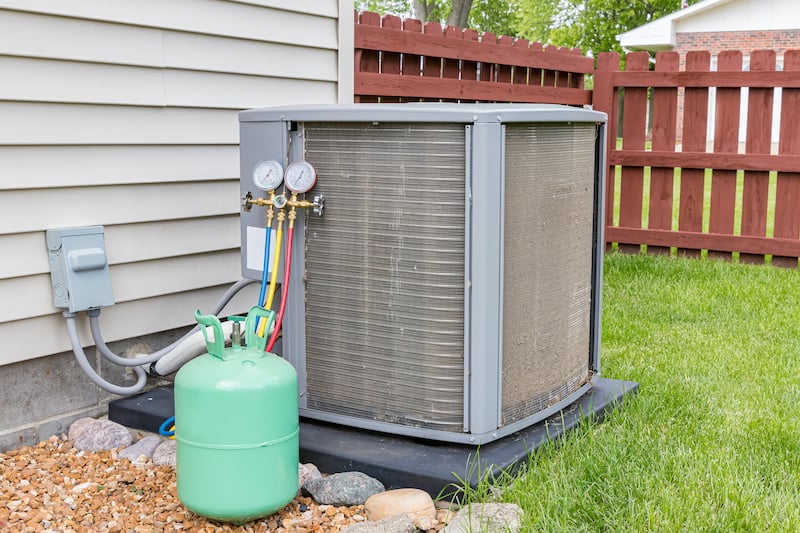
Your AC is struggling and it’s 105 degrees outside. You don’t have time for a vague answer. Here’s what we actually see most often in Central Valley homes, why it happens, and what it costs to fix.
Why Central Valley AC Systems Take a Beating
Most of California doesn’t understand what Central Valley summers actually demand. We’re not talking about coastal breezes or 80-degree afternoons. In Modesto, Turlock, Fresno, and Merced, temperatures regularly hit 105 to 115°F and stay there for weeks. Your AC runs 10 to 14 hours a day during peak summer.
That kind of continuous load is hard on every component. Add in the agricultural dust and particulate common throughout Stanislaus and San Joaquin Counties and your coils and filters take on more than a typical system ever would. Central Valley systems see certain failures more often, and usually sooner. Knowing what to watch for helps you catch problems before they turn into expensive failures.
Is Your AC Actually Broken? Start With the 20-Degree Rule
Before you call for a repair, check whether your system is failing or simply working against a 105-degree afternoon. A healthy central air conditioner generally holds your home about 20 degrees cooler than the outdoor temperature. At 105°F outside, an indoor temperature of 78 to 85°F is normal, not a breakdown.
During peak heat you should also expect longer run times, and near-continuous operation through the late afternoon is common in July and August. Bills higher than a mild month are expected too, though a dramatic jump compared with past summers is worth looking into.
If your home holds a steady temperature inside that 20-degree window and humidity feels controlled, your system is most likely performing as designed. If it cannot close that gap, blows warm air, or cycles on and off rapidly, that is when the repairs below come into play.
The 5 Most Common AC Repairs We See in the Central Valley
1. Refrigerant Leak
Refrigerant doesn’t run out on its own. If your system is low, there’s a leak somewhere in the lines or coils. Low refrigerant means the system can’t absorb heat effectively, so you get warm air at the vents and a unit that runs constantly without cooling your home down.
Repair cost: $200 to $1,500, depending on where the leak is, how long it takes to locate, and what refrigerant your system uses. Older systems running R-22 cost significantly more to recharge because R-22 is no longer manufactured and supply is limited. Newer systems run R-410A, and the industry is beginning a transition to R-454B. If you have an older system and the repair estimate is high, a replacement might be a better long-term option.
2. Capacitor or Contactor Failure
The capacitor is the part that starts and runs your compressor and fan motors. The contactor is the electrical switch that controls when the system powers on. Both take a beating in Central Valley summers, because your system cycles on and off dozens of times a day in extreme heat.
A failed capacitor is one of our most common summer emergency calls. Symptoms include a system that hums but won’t start, clicks without turning on, or shuts off mid-cycle. The repair is straightforward and the part is inexpensive. Expect to pay $150 to $400, including labor.
3. Dirty or Clogged Evaporator and Condenser Coils
The evaporator coil inside your air handler absorbs heat from your home. The condenser coil in the outdoor unit releases that heat outside. Both need to be clean to transfer heat efficiently. In the Central Valley, agricultural dust, pollen, and field particulate coat outdoor coils faster than in most other markets.
Dirty coils reduce efficiency and make your system work harder. Left too long, they can cause the system to overheat and fail. Coil cleaning runs $100 to $400. If a coil is physically damaged or corroded past cleaning, replacement costs $600 to $2,000. This is one of the repairs most often caught early during an annual tune-up, which is one reason regular maintenance pays for itself.
4. Frozen Evaporator Coil
If you’re seeing ice on your indoor unit or getting warm air from the vents, a frozen evaporator coil is a likely cause. The freeze-up is almost always caused by something else: restricted airflow from a clogged filter or blocked return, or low refrigerant. The ice is a symptom, not the root problem.
When you notice this, turn the system off and let it thaw completely before restarting. Running it while frozen can damage the compressor. Once thawed, check your air filter. If it was clogged, replacing it may resolve the issue. If the problem repeats or the filter was clean, call for a diagnostic. Repair costs run $200 to $600 depending on whether it’s an airflow fix or a refrigerant issue.
5. Thermostat or Electrical Control Failure
Sometimes the AC itself is fine and the problem is in the controls. A thermostat that’s reading temperature incorrectly, losing its connection, or failing to signal the air handler properly can make a healthy system behave like a broken one. Control board failures are less common but more expensive to diagnose and fix.
Thermostat replacement runs $75 to $300 depending on the unit. Control board replacement is typically $300 to $600. If your system is having electrical control issues and your thermostat is older, it’s worth considering an upgrade at the same time. We install the Honeywell Home ElitePRO smart thermostat, which gives Central Valley homeowners better control over how hard their system works during peak summer heat.
How Much Does AC Repair Cost in the Central Valley?
Here’s a quick reference for the repairs we handle most often. Prices reflect Central Valley market rates as of 2026 and vary based on your system’s age, brand, and parts availability.
| Repair | Typical Cost Range |
|---|---|
| Refrigerant recharge | $150 to $400 |
| Refrigerant leak repair | $200 to $1,500 |
| Capacitor replacement | $150 to $400 |
| Contactor replacement | $150 to $350 |
| Coil cleaning | $100 to $400 |
| Evaporator coil replacement | $600 to $2,000 |
| Thermostat replacement | $75 to $300 |
| Control board replacement | $300 to $600 |
We charge a flat diagnostic fee that applies toward the cost of the repair. You’re not paying separately for the call and the fix.
When Repair Doesn’t Make Sense Anymore
There’s a general rule worth knowing: if a repair costs more than 50% of what a new system would cost and your unit is 12 to 15 years old or more, replacement is usually the better financial decision. You avoid putting significant money into a system near the end of its service life, and a new system brings efficiency gains that reduce your monthly cooling bills.
We’ll always give you an honest answer on this. If your system can be repaired at a reasonable cost, we’ll say so. If replacement makes more sense, we’ll say that too. See our guide to AC replacement costs in the Central Valley for what a new system typically runs in this market.
How to Avoid These Repairs with Annual Maintenance
Most of the repairs on this list are either preventable or caught early during a professional AC maintenance visit. A standard tune-up checks refrigerant levels, inspects and cleans coils, tests the capacitor and contactor, and verifies electrical connections. That’s the same component list that accounts for the majority of summer breakdowns.
Scheduling maintenance in spring, before temperatures climb, is the most practical thing a Central Valley homeowner can do. You avoid the summer rush, catch problems while they’re still minor, and go into the hottest months knowing your system has been serviced. Call us at (209) 632-7596 to schedule.
Frequently Asked Questions
How much does AC repair cost in the Central Valley?
Most repairs run $150 to $600 for common issues like capacitor replacement, refrigerant recharge, or thermostat swap. More involved repairs, like an evaporator coil replacement or a refrigerant leak repair, can run $600 to $2,000. Wally Falke’s charges a flat diagnostic fee that applies toward the repair cost, so you’re not paying separately for the call and the work.
Why does my AC stop working in the middle of a heat wave?
Heat waves push every component in your system hard at once. The most common culprits are capacitor failure, low refrigerant, or a tripped disconnect. If your system shuts off during peak heat, turn it off for 30 minutes to let the compressor cool, then restart. If it trips again, call for a diagnostic. Running a failing system compounds the damage.
Is it worth repairing an older AC unit?
If the repair cost is less than 50% of a replacement and your unit is under 12 to 15 years old, repair usually makes financial sense. If the repair is expensive and the system is aging, replacement is worth a closer look, especially with current efficiency rebates available in California.
How long do AC repairs take?
Most common repairs, including capacitor replacement, refrigerant recharge, and thermostat swap, take one to two hours. Coil replacement or a more involved diagnostic can take a full day. We give you a time estimate before starting any work.
Can I prevent common AC repairs?
Annual maintenance prevents or catches most of the failures on this list. A tune-up checks the capacitor, refrigerant levels, coil condition, and electrical contacts before they become problems. Scheduling in spring, before temperatures climb, keeps you ahead of the summer rush and the longest wait times.
Call Wally Falke’s for AC Repair in the Central Valley
We’ve been servicing homes in Modesto, Turlock, Fresno, Merced, Ceres, Riverbank, and Oakdale since 1969. Our technicians are NATE-certified and licensed. We offer same-day service during summer when our schedule allows, and we charge a flat diagnostic fee that applies toward the repair.
Call (209) 632-7596 or request an appointment online. If your AC isn’t working the way it should, we’ll tell you exactly what’s wrong and what it costs to fix it.